Fieldnotes · City Atlas
Keep the reason.
Make the plan.
A saved place is more useful when you remember why it mattered. Fieldnotes turns that personal context into a small, deliberate shortlist.
What is shown: a working browser demo · fictional places and sample sources · not a shipped product.
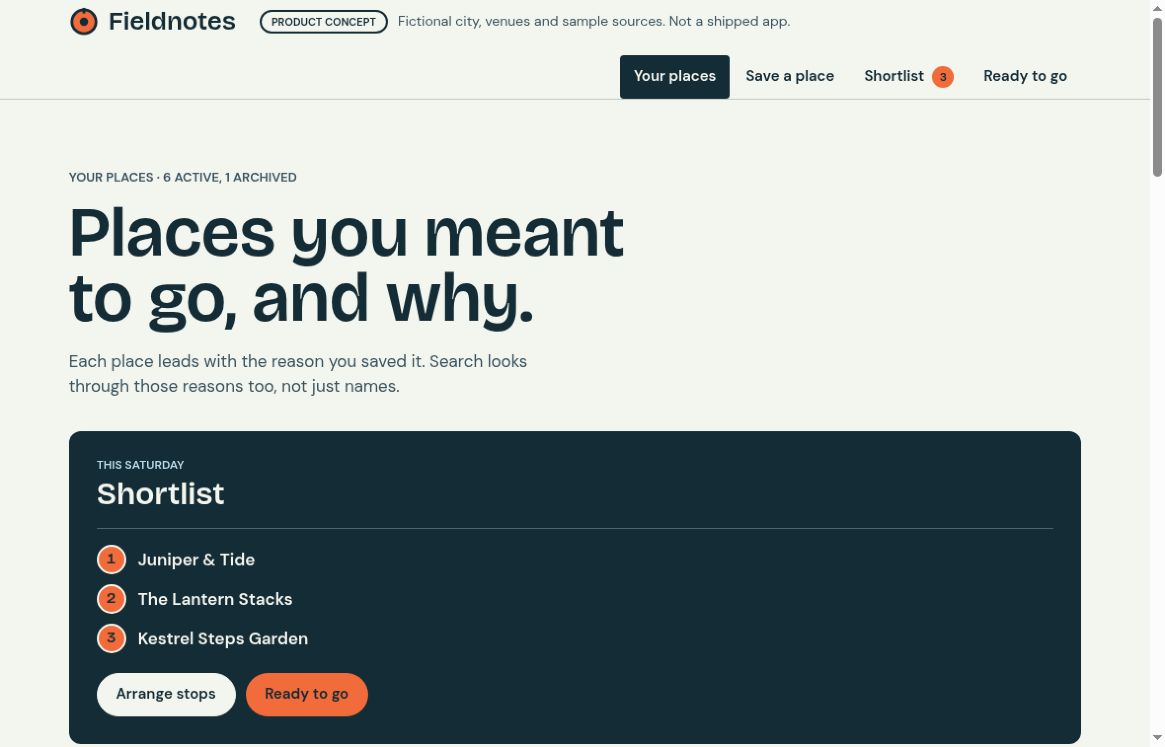
Remember what made it worth saving.
The saved list puts a personal reason beside each place. Search can find a fragment of that note, not only a venue name.
Actual prototype capture · view full size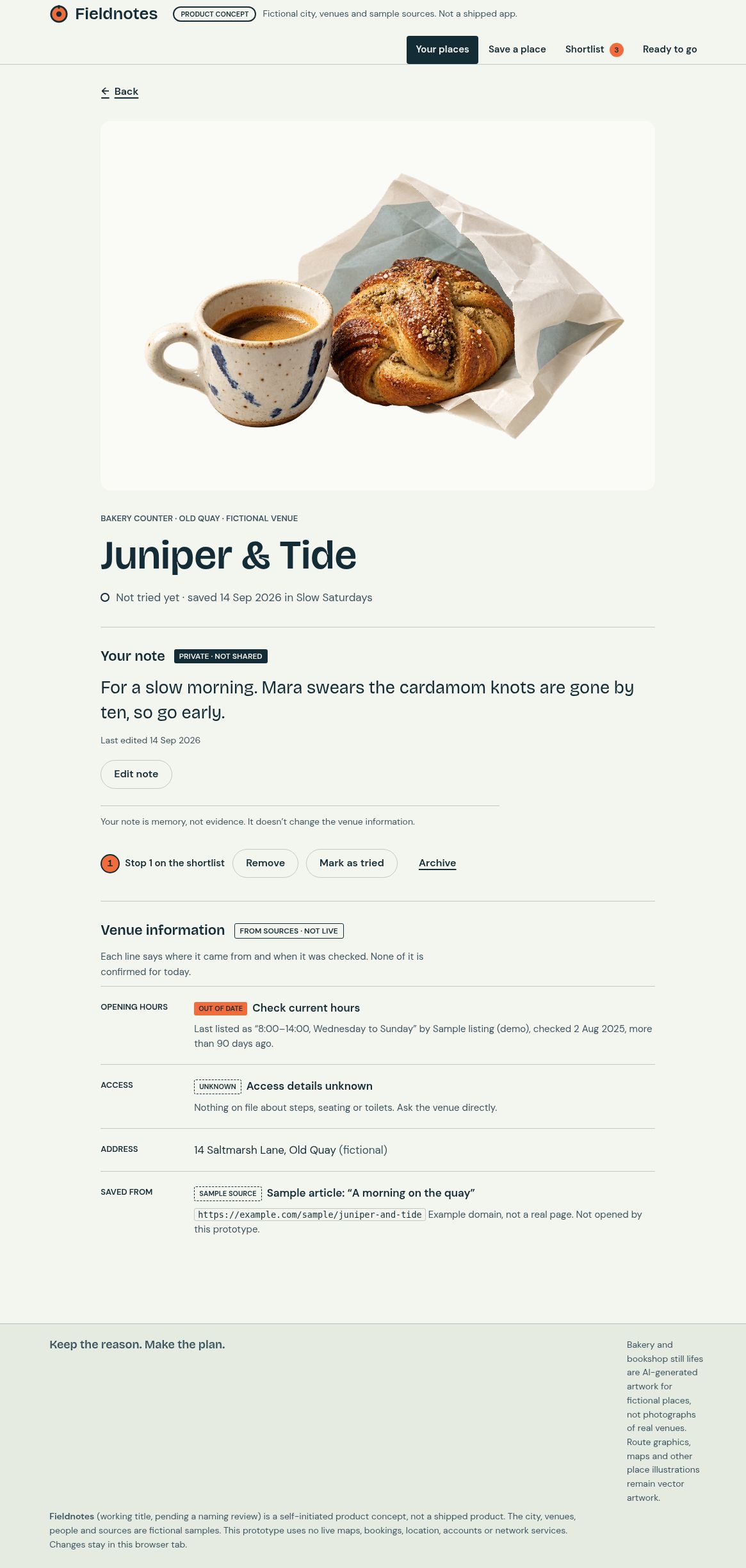
Your memory is not a venue fact.
The place detail keeps private notes separate from source information. Unknown or stale hours remain something to check, not a promise that a venue is open.
Actual prototype capture · view full size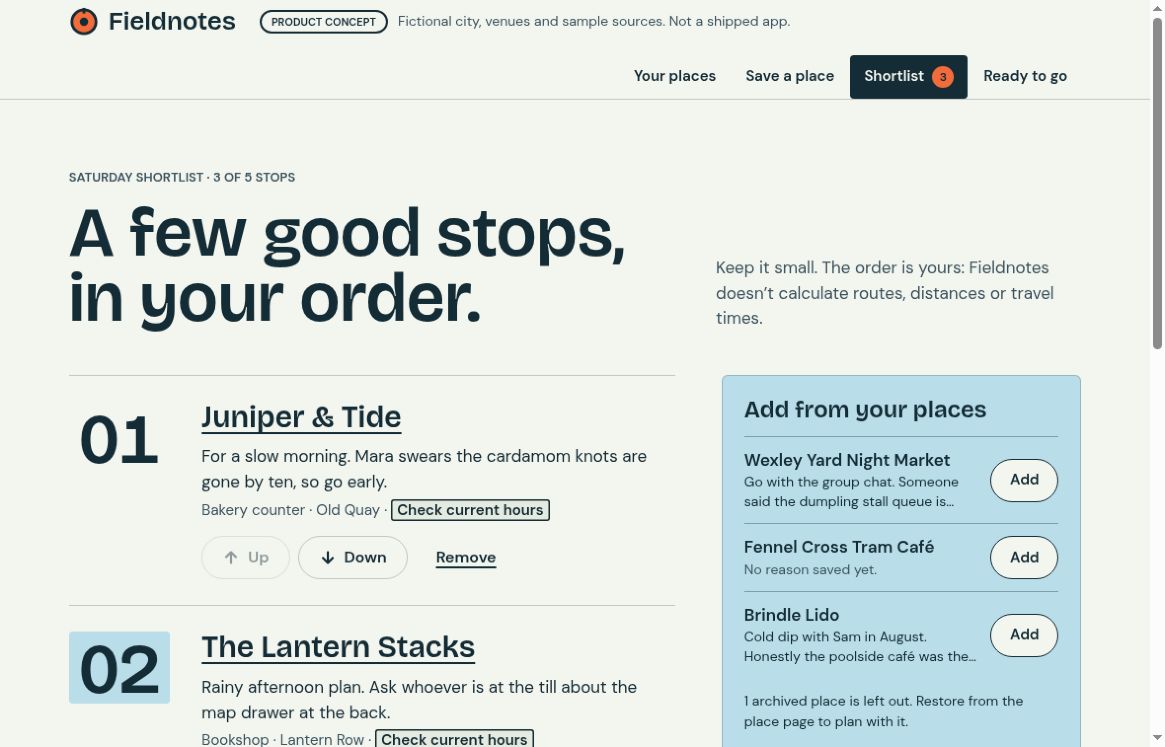
A few possibilities, in your order.
Add, remove and reorder stops without turning a relaxed outing into an optimized itinerary.
Actual prototype capture · view full size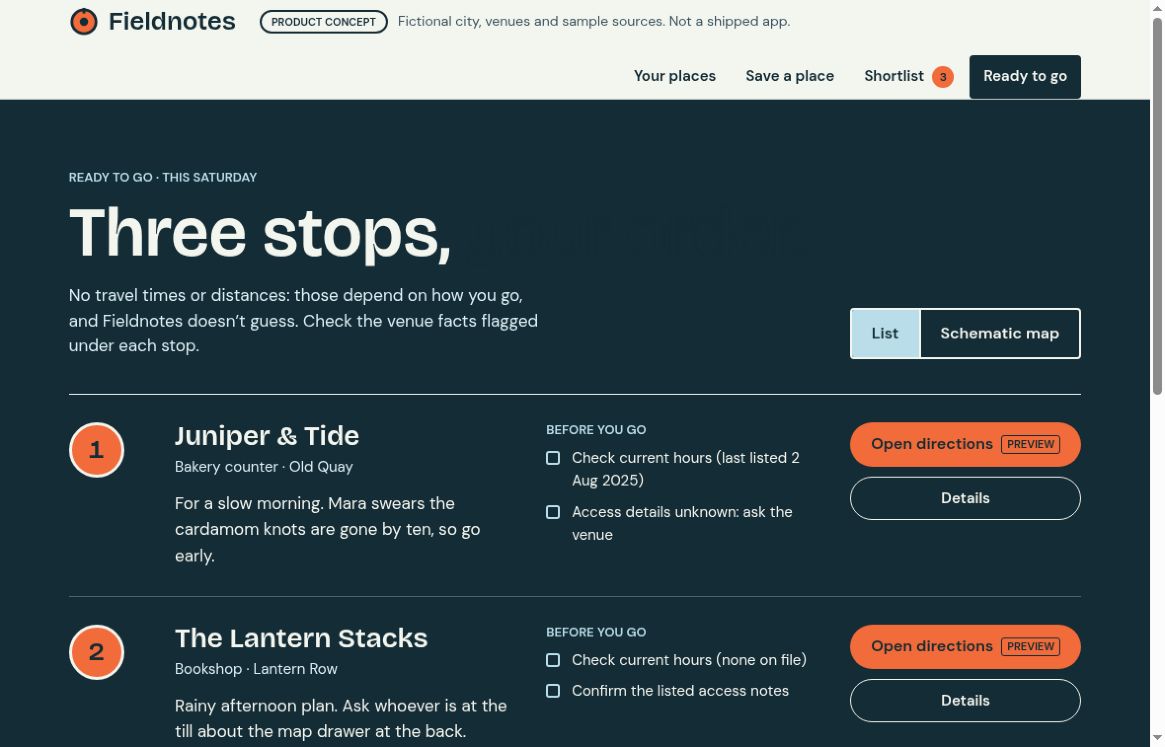
Take the plan with you.
List and schematic-map views share the same stops. Directions are a labeled preview, not a live route.
Actual prototype capture · view full sizeThe starting point
Save the context.
Not just the address.
A recommendation often arrives with a reason: a slow morning, a rainy-day backup, somewhere to go with a friend. A name in a long list can lose that context. This concept asks whether preserving the reason makes it easier to choose a small outing later.
The initial audience is a hypothesis: city residents planning a low-pressure half day with one friend. It is not a claim based on completed interviews.
- My role
- Independent product design & creative direction
- Disciplines
- Product · UX / UI
- Scope
- Product direction, visual system, interactive concept and refinement. No client commission or production launch.
Thinking & evidence
The value is in remembering.
Not another save button.

Category research found that saved lists, notes, tags and imports already exist. Those features alone are not a differentiation claim. The design hypothesis is the sequence: save a reason, retrieve it later, then choose a few places.
Three visual directions were explored in this revision: City Atlas, Local Signals and Weekend Edition. City Atlas was selected for its clear wayfinding and personable editorial type, without borrowing the identity of a notebook.
What that changed
- A list comes before the map, so personal context leads.
- Writing a note stays optional; it never blocks saving.
- Manual entry is a real recovery path when the demo importer cannot read a link.
- Duplicate handling keeps the existing place and offers a way to add the new note.
Research references: Google Maps saved lists and Mapstr’s feature FAQ. Category context, not evidence of Fieldnotes usability or demand. No interviews, usability tests or commercial outcomes are claimed.
Design decisions & refinement
Less decoration.
A clearer reason to go.
The visual system pairs cool paper and deep ink with small persimmon accents and pool blue. Bricolage Grotesque brings character; DM Sans keeps the interface practical.
Refinement reduced heavy type, tight tracking, competing borders and ornamental numbers. A single aligned detail flow now moves from image to title, private note, actions and venue facts. Useful stop numbers and status indicators remain.
The image system combines twelve revised vector illustrations with three AI-generated still lifes for the bakery, bookshop and garden. The objects add texture; the route graphics and controls stay simple. None of the generated images is a photograph of a real venue.
The tradeoff is deliberate: expressiveness without hiding the information needed to decide. The schematic map helps explain order, but does not imply geographic precision, travel times or route optimization.
Result & next tests
A working concept.
Not a validated product.
The browser prototype supports saving, note editing, duplicate recovery, shortlist changes and list/schematic-map views. Its recovery states include empty collections, simulated offline conditions, declined location, unavailable maps and stale information.
What was checked
57 automated tests and desktop/mobile functional QA check the implementation. This is technical QA—not participant usability research, proof of demand or a commercial outcome.
The next test is with people who already save local recommendations: can they return to a reason, choose a small outing and identify which venue facts still need checking? Compare that task with their current workflow before claiming an improvement.
No live APIs, maps, bookings, location requests or accounts. Ordinary demo changes use sessionStorage in the browser tab; clean capture mode uses sample data instead. Do not enter sensitive information. Fieldnotes is a working name, pending naming review.
Explore the working demoCredits & production status
Creative direction and review by Chi Alexander, with AI-assisted design and implementation using Claude Opus 5.5. Supporting still lifes and the decorative pencil/paper motif are AI-generated artwork. The revised vector collection also has native Rive editable artboards; this is not a claim of finished motion production or a shipped Rive runtime.
Screen images above are captures of the actual interactive prototype, not generated interface mockups. All venues, people and sources in the demo are fictional samples.